Key Takeaways
- Web app development costs are from $10,000–$15,000 for a simple MVP to $500,000+ for an enterprise platform – the price varies by complexity, team geography, technology stack, and timeline.
- Most mid-size web apps (SaaS products, customer portals, internal tools) are between $50,000–$150,000, but this is only if they have a clear scope and are built by Eastern European or LATAM teams.
- Over the last few years, the total cost of developing a web application has usually been 2,5–3,5× due to maintenance, infrastructure, security updates, and new features that add to the budget.
- AI tools like GitHub Copilot and Cursor speed up the development of standard features up to 35%, so it’s worth asking your vendor about AI-assisted engineering.
- Most web projects go over budget because there's no discovery phase at the start, leading to unclear scope and changes during development.
- Your contract should clearly state that you own the code after final payment and include an NDA to protect your business information, source code, and user data.
A booming SaaS company came with a request to build a customer platform. The vendor estimated their project at $50,000. This number was within a client's budget. And the project got the green light to start.
Six months later… and the SaaS company modified goals, added extra integrations, and underwent several rounds of rework. But the surprise came later when the final web app development costs went over $80,000.
Sadly, many companies face this issue. They often start web application development without realizing how much they need to pay. The result: delays, a higher budget, and frustration. Nobody deserves to go through this.
Regardless of what you are told, the price of custom software development solutions is not fixed. And the reason is pretty obvious: you need to make many choices along the way – features, tech stack, integrations, and much more. The better you know them, the higher the chances that you’ll avoid surprises.
In our article, we’ll reveal the truth about web application development costs that not all vendors want to share: where your money goes, how you can save with AI, and how to find an honest development partner.
What Is a Web Application? (And Why the Type Affects Price)
A web application is software that functions in your browser, so businesses can share information with users and deliver services online. While static websites are rigid and inflexible, web apps are dynamic and allow for logging in, searching, and data processing. Web apps can be different.
- Single-page applications are fast and interactive, loading on a single web page.
- Progressive web apps offer mobile-like features such as push notifications and offline access.
- Multi-page apps have separate pages for different functions.
- Enterprise portals are complex platforms with workflows, integrations, and user roles.
- SaaS platforms are full-scale products built for many users and are designed for continued scaling.
Each type affects the web application development cost estimation. Simple apps are faster and cheaper to build. Complex platforms need better planning, more integrations, and robust architecture, which all increase the budget. Here’s the table with prices you may pay for web development services.
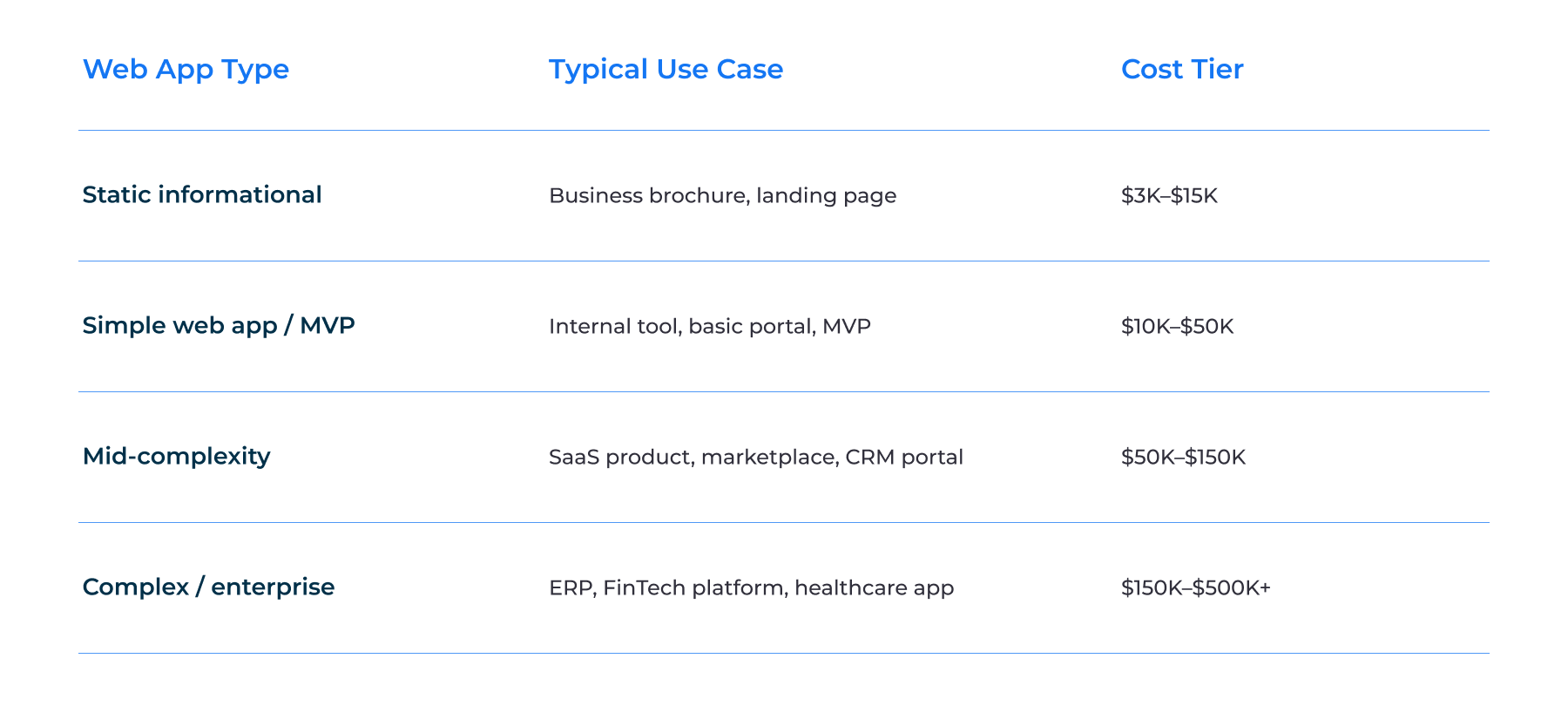
N.B.: But mind please, these figures show average market rates. The cost of your project may vary due to its scope, complexity, technology stack, and business requirements.
Web App Development Cost at a Glance: 2026 Price Ranges
The question “How much does it cost to build a web app in 2026?” is the one most often asked by clients. That’s why we’ve prepared the table with web app development costs based on Eastern European and LATAM outsourcing rates.
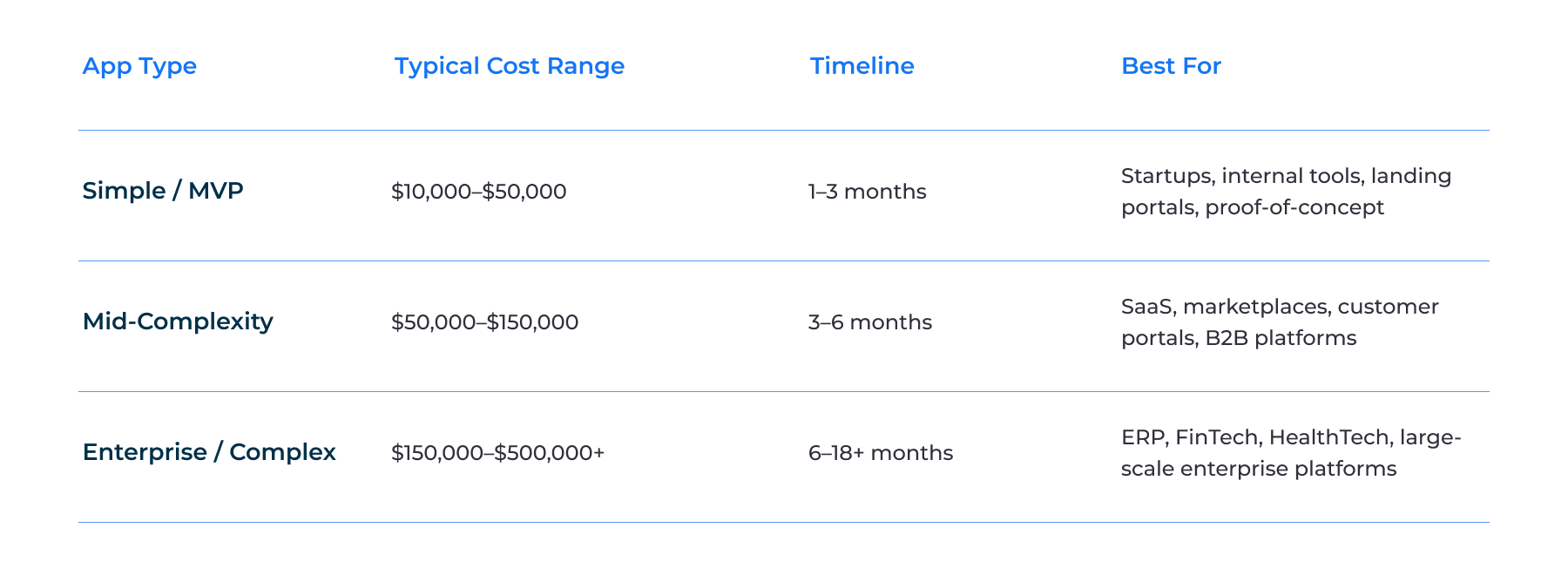
N.B.: These cost ranges for web development outsourcing are relevant for Eastern Europe and LATAM. If you’re interested in US and Western European agencies, be ready to pay 2–3× more. These figures cover only development costs. You need to plan your budget also for infrastructure, support, security, and further improvements.
The prices above are based on typical market estimates. Your actual development cost will depend on your project's specific requirements, features, integrations, and timeline.
8 Key Factors That Determine Web App Development Cost
Custom web application development cost depends on more than just features. In fact, the final budget of your solution is the result of numerous choices. First, decide which features and integrations to add. Second, think about security upgrades to protect your system. Finally, consider what team you need and where you’ll outsource it. Only after this, you’ll set realistic expectations and avoid costly surprises.
Project complexity and feature scope
If you need a custom enterprise software, you should be ready to invest more in its engineering. So, if your web application has standard features, you can expect less budget. But if you need an AI-based platform with advanced analytics, your investments will be higher. See how your budget can bump up with extra requirements.
But, consider, please, the costs shown are general market estimates. We provide a tailored quote after evaluating your business goals, technical requirements, and project scope.
- Setting up user roles and access levels – +$5000-$20,000
- Shared real-time workspace – +$20,000-$60,000
- Machine learning recommendation engine – +$30,000-$80,000
One of the highest hidden costs is scope creep, when new features are added during development, driving up both time and money.
Technology stack selection
How much does the tech stack affect website development cost? In this case, you should consider not only the technologies but also how well your solution performs and how easily it can be scaled over time. So here is the table with cost ranges for frontend, backend, and cloud services.
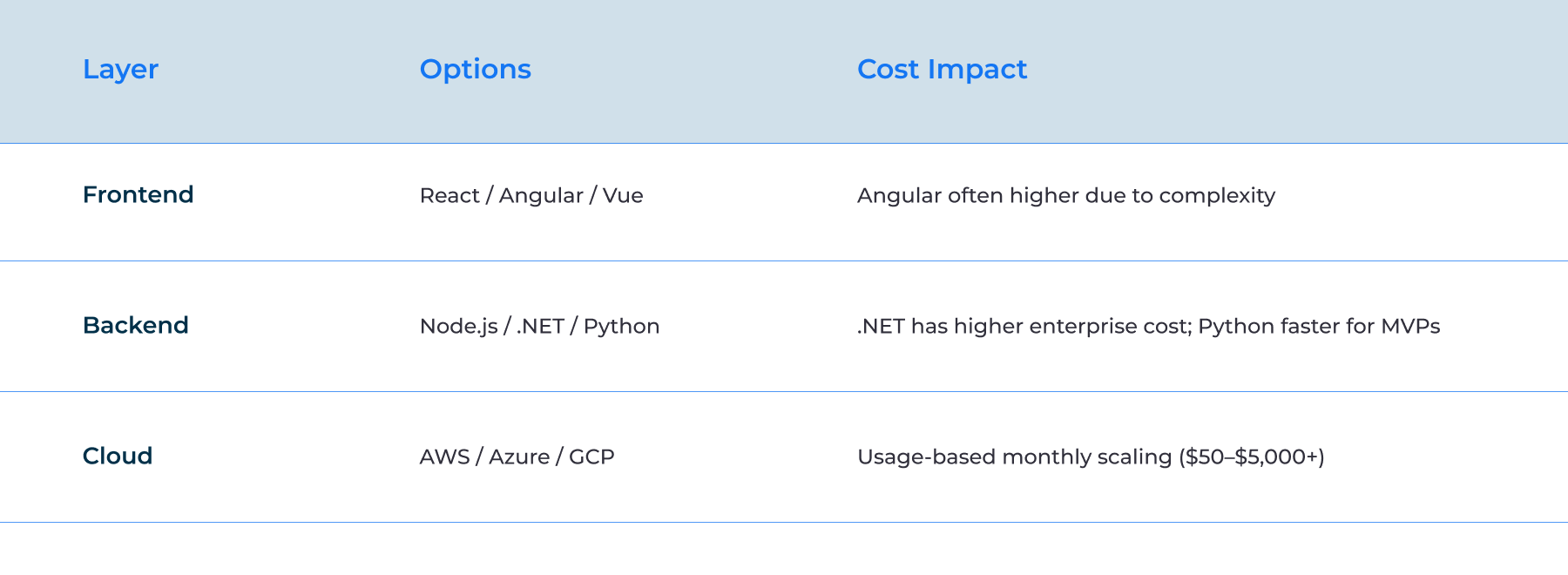
N.B. 2026 insight: AI-assisted tools like GitHub Copilot, Cursor, and Claude can cut standard development time by 20–35%, especially for simple features.
Don’t forget to ask your vendor how much of your code is AI-assisted, and how they guarantee quality, security, and consistency when using AI in development.
UI/UX design complexity
UI/UX design cost depends on how far the design process goes. For a basic UI with simple screens, you’ll pay between $5K and $15K. For a full custom design system with wireframing, prototyping, and custom illustrations, your budget can range from $20K–$60K. But indeed, this is a good investment as you will avoid expensive redesigns later.
Development team location and hiring model
When you outsource a tech team, geography can also affect web app development cost estimates. But rates are not the only factor to rely on. Focus on communication style, time zone differences, IP protection, and cultural values. Add here talented engineering, high English proficiency, and competitive rates, and the choice will be software development in Eastern Europe.
Eastern Europe is one of the regions that offers the best balance of cost, technical expertise, and cooperation style.
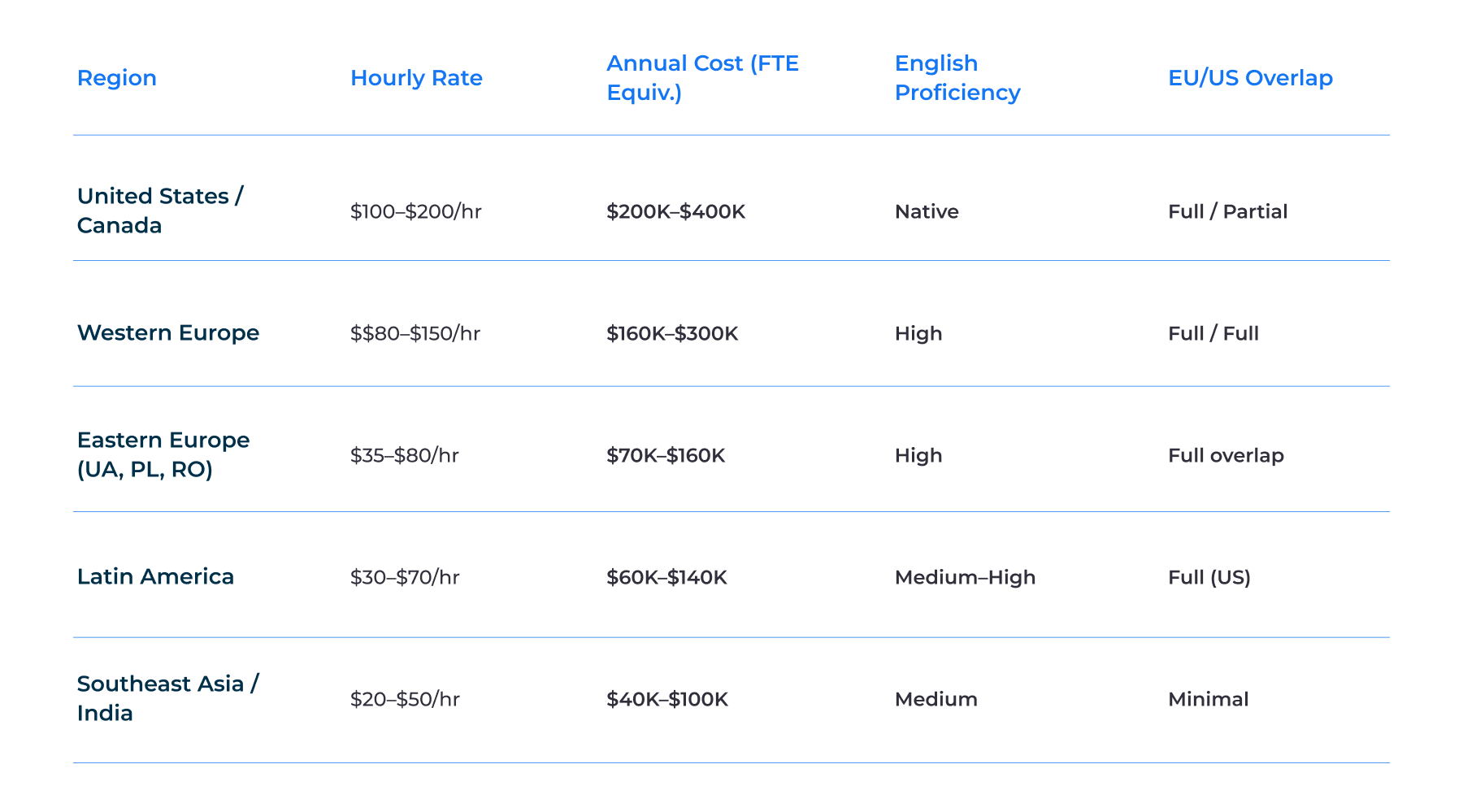
The prices above are average market estimates. Your final project cost may vary based on your specific requirements.
In-house vs. freelance vs. development partner
The hiring model can affect both your project budget and success. Yes, freelancers are the lowest rated, but you’re not protected against delivery risks. With an in-house team, you can control everything, but it’s expensive. Development partners offer a balance of expertise, speed, and on-time delivery. Here’s the table with these models for comparison. But these figures show average market rates. The cost of your project may vary depending on its scope, complexity, tech stack, and business requirements.
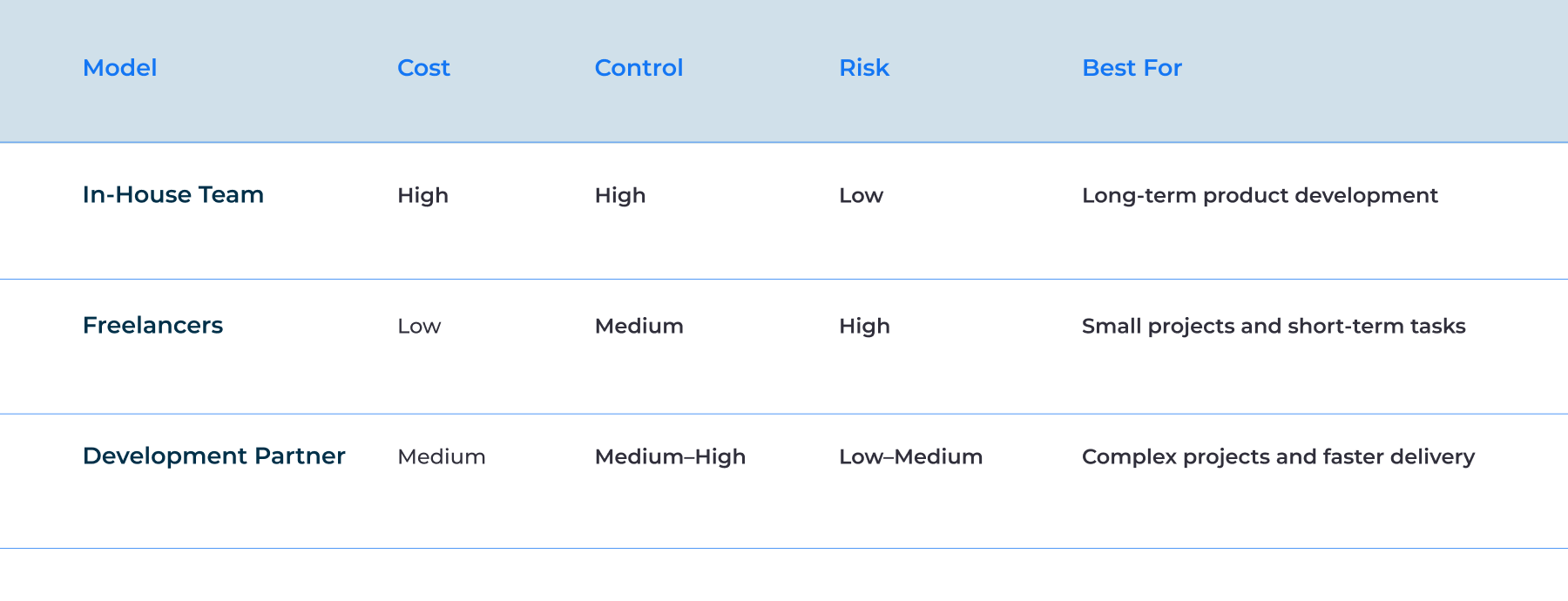
When calculating costs, you should include hiring, onboarding, benefits, and management. Hiring an in-house developer can take 4–8 weeks before they start your project, while an experienced development partner can often begin ASAP.
Third-party integrations and APIs
Integration with third-party APIs can also add cost and development time. Here are the price ranges of the most requested integrations:
- Payment gateways – $5K–$20K
- CRM or ERP integrations – $10K–$40K, SSO
- Identity providers – $3K–$10K
- Analytics tools – $2K–$8K
- Maps or geolocation – $3K–$12K
Many of these services also have continuous subscription or usage fees that are not always included in the initial pricing. Just a friendly reminder: your actual development cost will depend on your project's specific requirements, features, integrations, and timeline.
Security, compliance, and regulatory requirements
Certainly, security and compliance can hike the price of your web application. Meeting GDPR, HIPAA, PCI-DSS, or SOC 2 is a must if your system stores sensitive data, mostly personal information, healthcare records, or payment data. In this case, you need extra security measures. These are data encryption, user permissions, security testing, and audits – and all of which can add 15–30% to the project budget. But all this is done to protect your data and prevent future risks.
Project management and development methodology
The approach to your project management influences cost, speed, and final quality. Agile methodology works better for web apps because delivery is controlled and done in a step-by-step manner. A Waterfall approach can be risky for web development because once the project has started, it’s difficult to make changes. With Agile sprints, it’s also possible to predict outcomes, but for this, you need a detailed plan, reviews, and documentation.
How does this influence your budget? Strong project management prevents rework, scope creep, and misunderstanding, thereby cutting overall expenses. Plus, with a dedicated PM, you don’t need to involve an internal team as delivery is on track.
Web App Development Cost by Phase: Stage-by-Stage Breakdown
The truth is that not all of your budget goes into coding. You need to pay for planning, design, testing, deployment, and continued support. Here’s a table with realistic pricing for each stage to help you avoid surprises. But the costs shown are general market estimates. We provide a tailored quote after evaluating your business goals, technical requirements, and project scope.
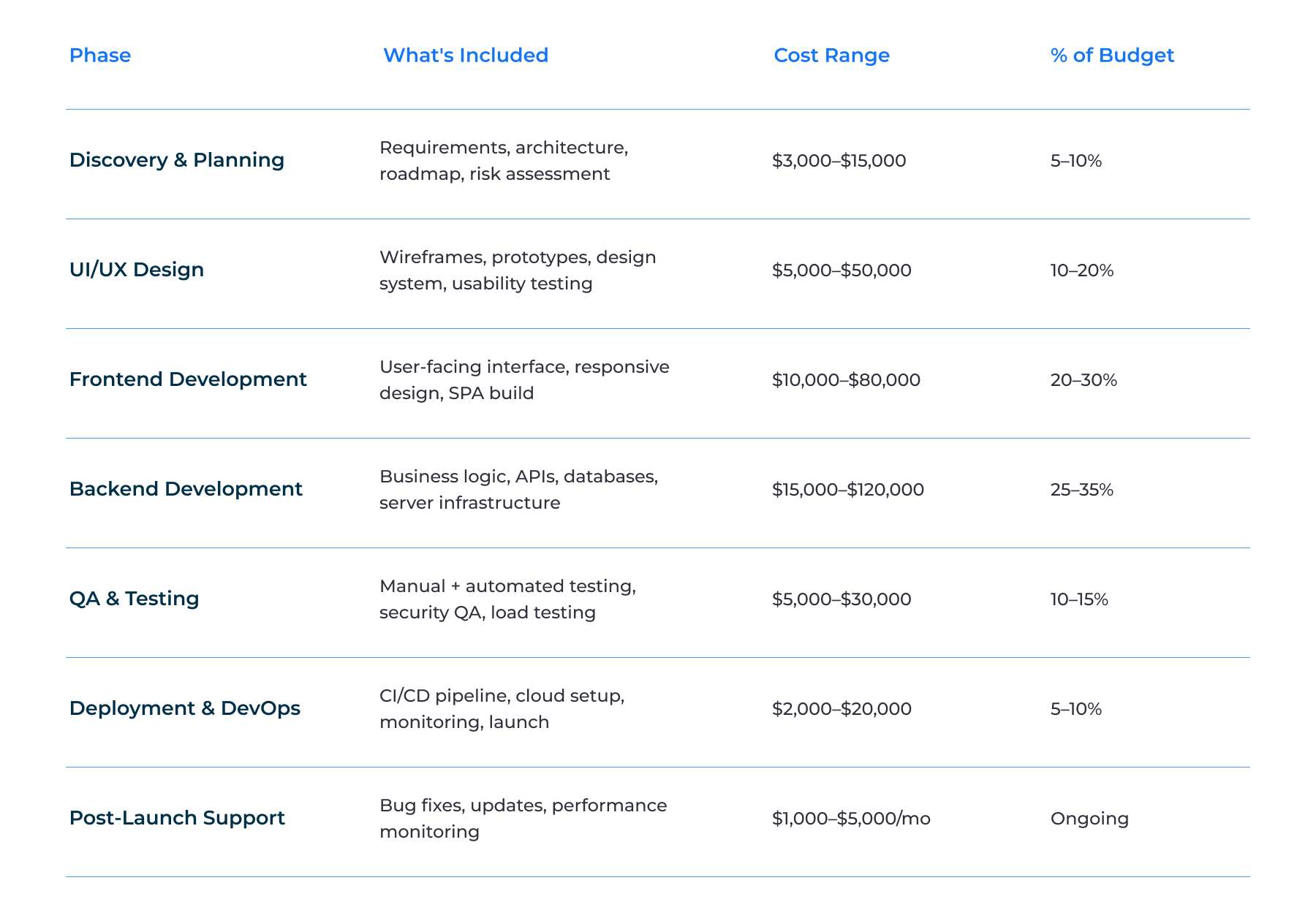
- Discovery & requirements (5-10%): For what are you paying here? Project scope, business requirements, architecture, risks, and delivery roadmap. If you start with discovery, you’ll avoid expensive rework and redesign later.
- UI/UX design (10–15%): At this phase, you need to pay for user research, wireframes, prototypes, and visual design. This investment is justified as it lowers redesign costs.
- Development (50–65%): This is the biggest cost item: frontend and backend development, database design, integrations, APIs, and core business logic.
- QA & Testing (15–20%): You can’t skip this phase if you want your app to work reliably and remain secure. Functional testing, security reviews, performance testing, and bug fixing – all this is conducted to guarantee the stable work of your system.
- Deployment & Launch (3–5%): At this stage, you pay for app deployment, infrastructure setup, monitoring tools, and everything needed to release your product.
- Maintenance & Support (15–25% annually): Yes, you may want to skip this stage. But we don’t advise it if you want to build the solution for the long term. Plus, continuous support ensures your app stays secure, reliable, and competitive.
Tip: Many companies plan a budget only for building and skip other app development stages, or invest less time and money in them. But our sincere recommendation is to include all these phases in your budget planning to avoid future issues.
Total Cost of Ownership (TCO): What Your Web App Really Costs Over 3 Years
A big mistake that businesses make is relying on the initial development estimate when planning a web app. It’s a way to crash your expectations. Indeed, development is only a year-zero investment. You’ll see the real cost of ownership over the next 3-5 years as the application scales and requires continued support.
- A realistic TCO estimate covers the following points:
- Ongoing app maintenance costs (15-25% of the early development cost per year)
- Cloud hosting and infrastructure costs ($200-$5,000+ per month, depending on traffic and complexity)
- Security updates and compliance re-audits
- New features, integrations, and scalability improvements
- Internal team costs or vendor contract renewals
For example, a web application that is priced at $150,000 to build may require an extra $200,000–$300,000 over the next three years for upkeep, infrastructure, security, and updates. So the true three-year cost of ownership can reach $250,000–$350,000.
When choosing a development partner, ask for a three-year TCO estimate, as this is the way to build a more realistic budget for your solution.
Web App Development Costs by Industry
Not all software costs the same to build. Industry-specific requirements also matter in budgeting. The final price can hike due to compliance, integrations, security standards, and workflow complexity. If you need your system to manage many regulations, data, and business processes, be prepared for high development costs. Here is the breakdown of app development costs by industry.
Just a friendly reminder: the prices above are average market estimates. Your final project cost may vary based on your specific requirements.
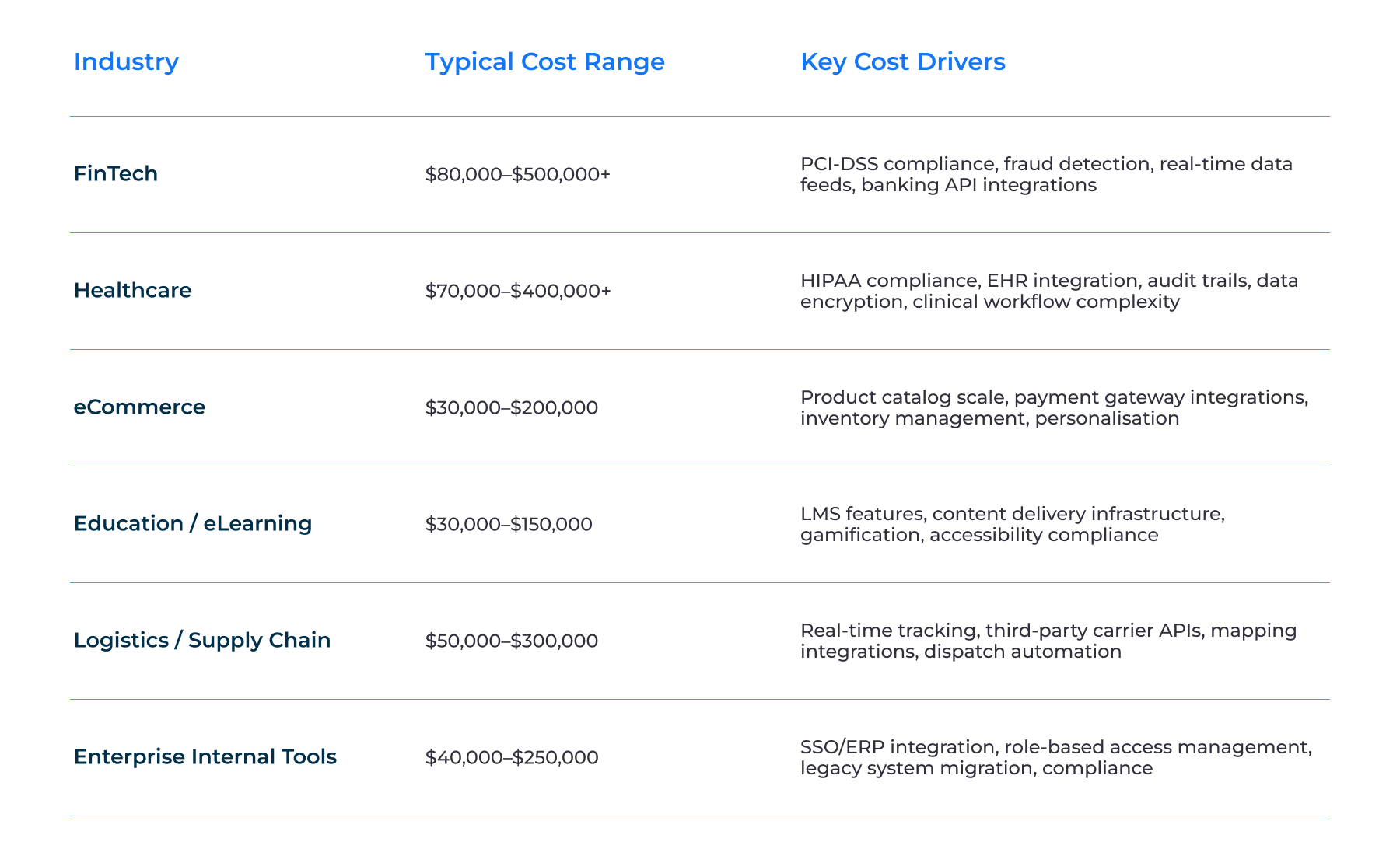
- Fintech: As a regulated industry, fintech apps are among the most costly to build because they manage sensitive financial data and transactions and require a high level of security and compliance.
- Healthcare: This vertical doesn’t lag behind in app development costs as it needs strong security controls and regulatory compliance to protect patient records, especially while building a web portal.
- E-commerce: Here, the price depends on software complexity and chosen features. Multi-vendor marketplaces with personalization are highly priced.
- Education/e-learning: In this industry, the more interactive and engaging the learning experience your app must deliver, the higher the development costs are.
- Logistics/supply chain: Logistics platforms frequently rely on real-time tracking and monitoring. And this cost item increases complexity and needs large funding.
- Enterprise internal tools: In this area, prices are high due to the need for automation and integrations with other systems.
Tip: We advise you to focus on industry-related regulations rather than the deadline price. Healthcare and fintech web apps are more expensive than e-commerce and e-learning apps due to security and compliance requirements.
Hidden Costs in Web App Development (What Most Estimates Miss)
The reason why most web app budget overruns is not a bad vendor as many used to think. The problem is that some costs were never included in the original estimate. Let’s see what cost items estimates may miss and how to achieve IT outsourcing cost optimisation!
- Data migration: Need to move data from old systems and databases? This will cost you from $5,000 to $30,000, depending on data readiness.
- Training and change management: Be ready to pay for user training, onboarding, and documentation if you’re planning to integrate new tools. And that will be between $2,000 and $15,000.
- Infrastructure and hosting: Costs for cloud services are often excluded from estimates. Always ask for a 12-month forecast of hosting costs.
- Documentation and handover: Not all can tell you, but your final budget fails to cover technical docs, API guides, and deployment instructions. But they are a must for long-term ownership.
- Post-launch fixes beyond warranty: Many contracts only cover 2 weeks of bug fixes. A safer scope includes 30-60 days of warranty for applicable issues.
- Localization and multi-language support: Planning to go globally? You need to pay $10,000-$40,000 for translations and UI adjustments.
- Legal and IP review: Reviewing contracts, IP ownership, and data agreements will add $2,000–$8,000 to your budget, but you can’t skip this for enterprise projects.
- Load testing and performance optimization: Pre-launch testing costs around $3,000–$10,000, but it helps avoid far more expensive production failures.
These figures are average market rates. The cost of your project may vary depending on its scope, complexity, technology stack, and business requirements.
Pricing Models: Fixed Price vs. Time & Material vs. Dedicated Team
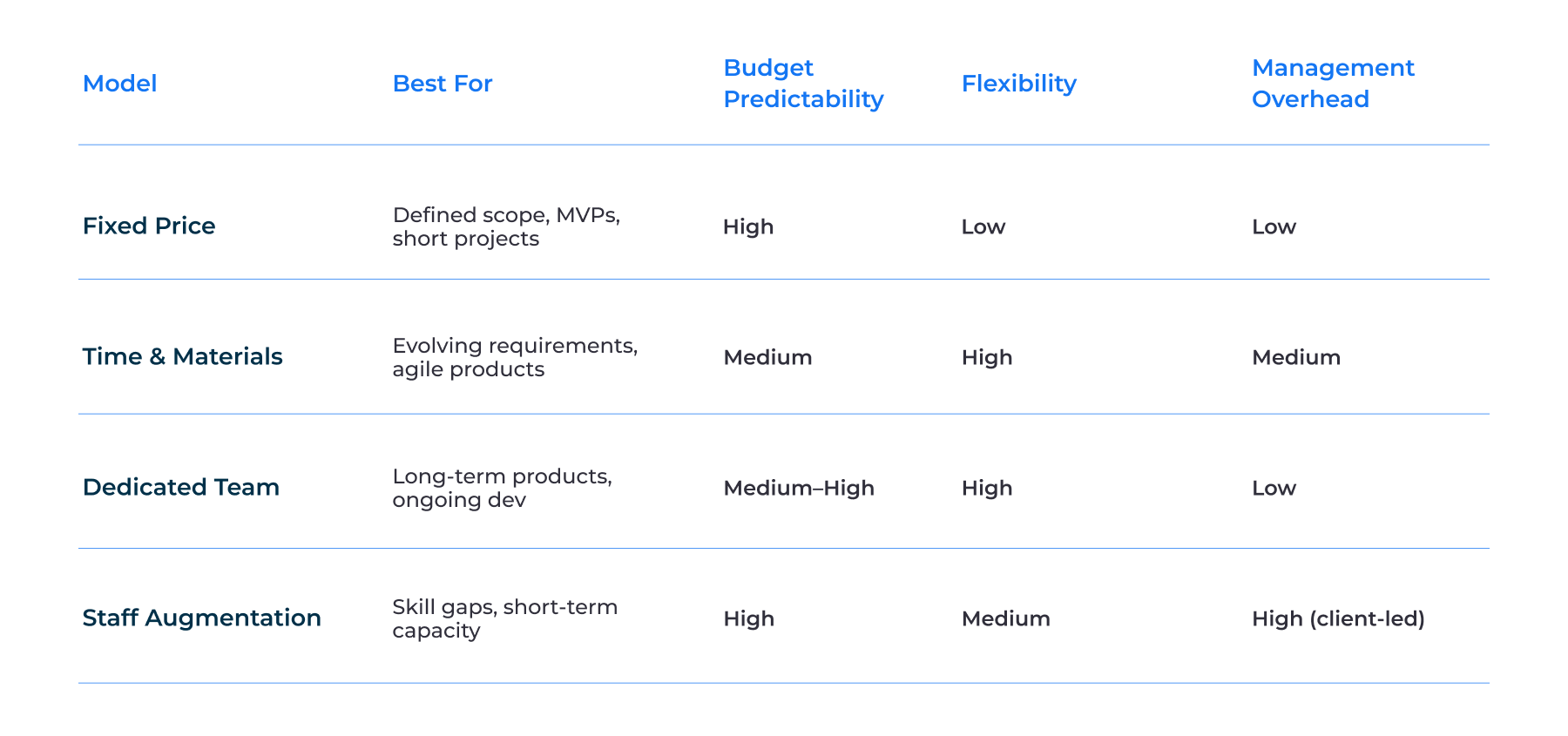
Fixed price, time-and-materials, or dedicated team? What pricing model to choose from? Each of them differs in the level of flexibility, spending control, and team involvement. Here are the characteristics of all three types, plus your project needs, and the choice will be made.
Fixed price
With a fixed-price model, you get a single quote for a well-defined scope of work. You know the budget in advance, so planning it isn’t a problem.
Best for:
- MVPs with a detailed scope
- e-commerce projects with a known feature set
- Projects under 3 months
Trade-offs:
- High budget predictability
- Rigidity for changes
- Scope changes require extra funding
Time & material
With T&M, you pay for the actual time spent on development. The project is delivered in sprints. So you can change requirements as your product scales.
Best for:
- Web applications with changing requirements
- Long-term digital products
- Projects that require continued discovery
Trade-offs:
- High flexibility
- Budget may change as the scope evolves
- Requires more active project involvement
From our experience, T&M projects have a lower rate of scope disputes during development because all changes are naturally integrated.
Dedicated development team
Why to hire a dedicated team? You get a stable crew that works only on your product. The team comes to know your business, goals, and codebase over time.
Best for:
- SaaS platforms
- Enterprise portals
- Long-term product development
- Companies that need continued engineering support
Trade-offs:
- Strong product continuity
- Deep understanding of your system
- Requires a longer-term commitment
Staff augmentation
If you want to scale your existing team with additional developers, IT staff augmentation is the best option. Your managers remain in control while specialists fill skill or expertise gaps.
Best for:
- React, Node.js, AI, or other specialist skills
- Temporary resource gaps
- Teams with strong internal leadership
Trade-offs:
- Fast access to talent
- Flexible team scaling
- Higher management involvement from the client
How AI Is Changing Web App Development Costs in 2026
Believe it or not, AI is quietly reshaping how software development teams build and price their web apps. The reason: AI is hidden inside systems, and we only notice that development is getting faster through intelligent automation. Let’s see what takes place in 2026:
- AI-assisted coding tools like GitHub Copilot, Cursor, and Claude speed up standard development tasks
- We deal with a 20-35% reduction in coding time for routine feature work (GitHub, 2024)
- With effective AI use, it’s possible to deliver a $100K web development project in the $70K–$80K range
- Teams are shifting from “writing every line of code” to “reviewing and refining AI-generated code”
- Senior engineers remain supervisors of AI-assisted development and are vital for architecture, security, and product decisions
- AI without senior oversight can increase risks like security gaps and technical debt
What does this mean in practice? Faster delivery for basic features, lower prices for well-scoped projects, and no reduction in the need for experienced engineers – all this proves that AI is just an instrument in the talented hands of a developer.
What you should ask your vendor: “How do you use AI in your development process?” “How does AI impact your cost estimate and timeline?”
At Intellectsoft, we use AI to speed up delivery, and AI-generated code is always reviewed and improved by our senior engineers to keep systems secure, scalable, and production-ready. Plus, we also rescue vibe-coded apps and turn them from fragile prototypes into working products.
Why Companies Choose Intellectsoft for Web App Development
The bitter truth is that most web applications fail not because of poor engineering but because of poor planning and uncertainty. When our clients come to us, they pay much attention to technical details.
We shift their focus from technologies to the project scope. Yes, we cover everything from business goals to future integrations. Why do we go so far? We want to provide realistic time and budget estimates. And we don’t lie to our clients by saying that they will get their product faster than they expected.
Why do we move step-by-step? We want our clients to receive outputs at every stage, share their feedback, and receive changes gradually, not just at the end of the project. All is under our control.
The point where companies come to us is not to “develop a web app,” but to build it in a structured, rational way, following a realistic roadmap.
We focus on cost, scope, architecture, and long-term ownership as these are the points that matter the most, and if we confirm with our clients, there are no budget overruns or technical debt.
Intellectsoft's Web Development Delivery Process
At Intellectsoft, we have a structured development process with clear outputs at every stage. So our clients understand where their budget goes and can validate progress before advancing.
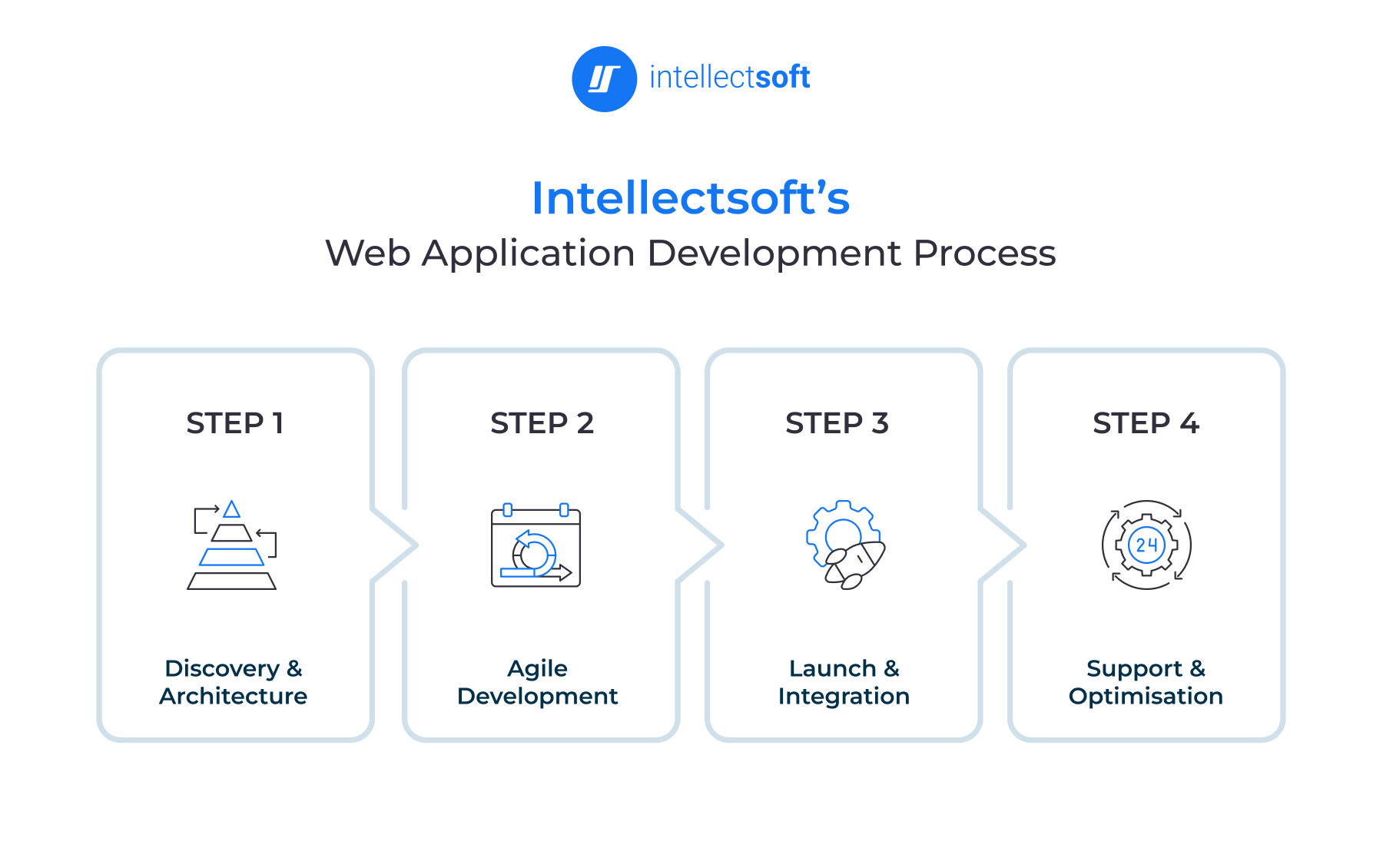
- Discovery & architecture (Weeks 1–3) – build the backbone of your future web app
We start the web app development process with discovery and architecture planning. First, we gather requirements and map user journeys. Then, we create UX wireframes, select the right technology stack, and design the robust architecture. Plus, we also spot possible risks and estimate the required effort.
In the end, you get a detailed project roadmap, a budget breakdown, and a total cost of ownership forecast. So you see what we will build, how long it will last, and how much you’ll pay.
- Agile development (Sprints 1–N) – build step by step, with full visibility
We use a sprint-based approach to delivery with regular weekly reviews, staged QA sign-off, and full client access to the project board. How do we speed up delivery if our clients ask? We offer AI-assisted development with senior engineer code reviews — all to guarantee high quality and swift delivery. Finally, we have a dedicated staging environment for safe pre-release testing and validation.
- Launch & Integration (Pre-launch week) – prepare for a flawless release
Before launch, we make sure your web app is ready for real users and real workloads. That’s why we conduct load testing and perform a security review. Plus, we validate deployment pipelines and optimize performance to reduce risks. Finally, we prepare documentation so your team can operate and support the solution after release.
- Support & optimisation (Post-Launch) – keep improving after launch
Deployment of your web app is not the end of the development journey with our client. After release, we provide SLA-based monitoring and a 60-day bug warranty. Plus, we offer continued maintenance and flexible support options. As your business scales, we continue to add new advanced features and integrations through a dedicated team or a time-and-materials engagement model.
Not sure how much it costs to build a web app? Send us a note, and we’ll break it down for you.
FAQ
How much does it cost to build a web application from scratch?
Web app development costs vary by your project complexity and team geography. Simple MVPs with core features are priced between $10,000 and $15,000. Mid-sized products such as SaaS tools, portals, or marketplaces cost from $50,000 to $150,000. Enterprise platforms can go over $500,000. You can expect this budget if you opt for Eastern European and Latin America software outsourcing. Hourly rates of US and Western European developers is often 2-3× more.
What is the average cost of web application development in 2026?
In 2026, a custom web application development pricing is around $75,000–$120,000 – this is if you need a mid-complexity solution built by a standard team from Eastern Europe. Simple MVPs range from $10,000–$30,000, while enterprise platforms start at $150,000 and more.
How long does it take to develop a web app?
Discovery phase – 2-4 weeks
Simple MVPs – 1-3 months
Mid-size web apps – 3-6 months
Enterprise platforms – 6-18 months or longer
What is the total cost of ownership for a web application?
If you’re the owner of a web app that's been in use for more than 3 years, the total cost of maintaining it is about 2,5-3,5 times the initial development cost. Each year, maintenance, infrastructure, security, and new features account for 15–25% of the original build cost.
Is it cheaper to hire in-house or outsource web app development?
Outsourcing to Eastern Europe is usually 40–60% cheaper than hiring an in-house team. When you scale your internal crew, the project budget should cover salaries, benefits, and other hiring and management expenses. If you want to deal with teams from the US and Western Europe, their services will cost 2,5-3× their base salary in total.
What are the ongoing costs after a web app is launched?
After launch, you need to pay for hosting, which can range from $200 to $5,000+ per month. Plus, your budget should include costs for upkeep, bug fixes, security updates, and new features. That’s why add here about 15–25% of the original build price each year. Before starting your project, agree on support terms with your vendor.
Can AI development tools reduce the cost of building a web app?
Yes. AI coding tools like GitHub Copilot and Cursor can help developers build standard features faster. That’s why it cuts the cost of web app development on larger projects. When picking a vendor, ask how they use AI in their workflow and whether this is included in their pricing.
How do I get an accurate estimate for my web app?
You’ll get an accurate web app pricing if you decide on a discovery phase. This is a good way to define the scope, create wireframes, and pick technologies. Yes, it’s costly — from $3,000 to $15,000. But it will protect against future issues. Have a solution idea to implement? Contact Intellectsoft for a free initial scoping session.
